Mastering Sourdough
Navigating the unpredictable yet deeply rewarding world of wild yeast fermentation.
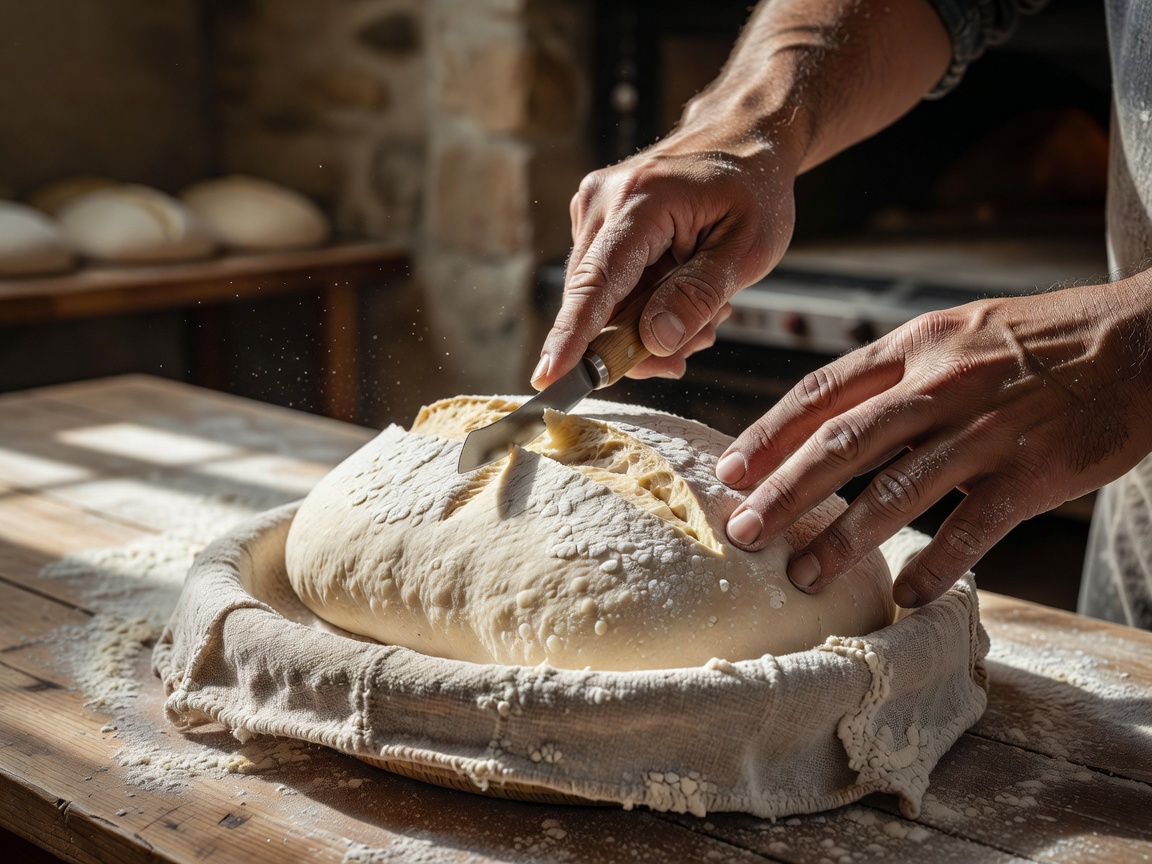
The Living Ingredient: Your Starter
Sourdough bread relies entirely on a culture of wild yeast and lactic acid bacteria—your starter. Unlike commercial baker's yeast, which provides a rapid and predictable rise, a sourdough culture is a living ecosystem that fluctuates based on temperature, feeding schedules, and flour types.
Maintaining a starter involves discarding a portion of the culture and replenishing it with fresh flour and water. The key to a robust starter is predictability in your feeding routine. Using a digital scale to feed your starter equal parts (by weight) of water and flour ensures consistency. Whole grain flours, particularly rye, provide more nutrients for the yeast and can help invigorate a sluggish starter.
You know your starter is ready to bake when it has doubled (or tripled) in volume, is bubbly on the surface, and has a web-like structure beneath. If it smells strongly of acetone or alcohol, it is hungry and needs more frequent feedings.
Understanding Hydration
In sourdough baking, hydration refers to the ratio of water to flour, expressed as a percentage. For example, a recipe using 1000g of flour and 750g of water is a 75% hydration dough.
| Hydration Level | Dough Characteristics | Final Crumb |
|---|---|---|
| Low (60% - 65%) | Stiff, easy to shape, holds form well. | Tighter crumb, uniform small holes. Ideal for sandwiches. |
| Medium (68% - 75%) | Sticky but manageable. Requires folding techniques. | Open crumb, irregular holes, chewy texture. |
| High (78%+) | Very wet, slacks easily, difficult to shape. | Very open, lacy crumb, delicate crust. |
Beginners should start with a lower hydration (around 68-70%) to master the feeling of dough development and shaping before attempting highly hydrated, difficult-to-handle doughs.
The Bulk Fermentation Phase
Bulk fermentation is the primary rising period for the entire batch of dough. It is arguably the most critical step in the sourdough process. Under-proofed dough will result in a dense loaf with a few large cavernous tunnels, while over-proofed dough will collapse and spread flat in the oven.
During bulk fermentation, baker's rely on a series of "stretch and folds" rather than traditional kneading. Wetting your hands, grasping one side of the dough, pulling it up, and folding it over itself helps develop the gluten network without tearing it. This process traps the gas produced by the yeast, giving the bread its structure.
Judging the end of bulk fermentation is a learned skill. The dough should feel airy, display a slight dome at the edges of the bowl, and jiggle slightly when shaken. Temperature plays a massive role here: a warm kitchen might speed bulk fermentation to four hours, while a cool kitchen could extend it to eight or more.
Baking: The Role of Steam
To achieve a deeply caramelized, blistered crust and maximum volume (oven spring), sourdough requires a hot oven and significant steam during the first half of the bake.
Steam keeps the exterior of the dough pliable, allowing it to expand fully before the crust hardens. The most accessible way for home bakers to trap steam is by baking the loaf inside a preheated cast iron Dutch oven with the lid on for the first 20-25 minutes. After this period, removing the lid allows the dry heat of the oven to crisp the crust and develop a dark, rich color.
Letting the bread cool entirely before slicing is mandatory. Sourdough continues to cook and set internally for hours after leaving the oven. Cutting a hot loaf will result in a gummy, wet interior that ruins the texture you spent days developing.